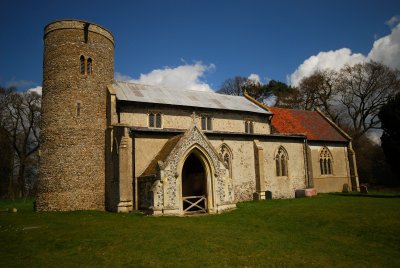
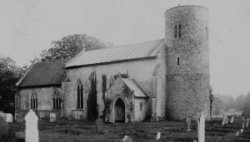
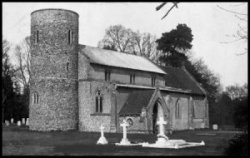
MERTON CHURCH
 |
 |
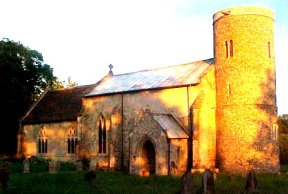
| .........Front
View |
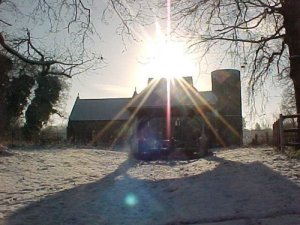
..........Rear
View |
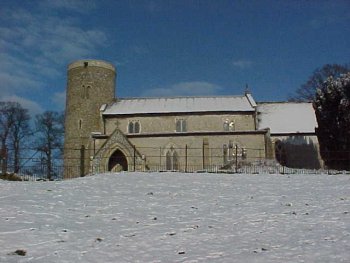
Saint Peter's Church situated on the edge of
Merton park, in its present form dates back to the 14th
century, however some parts dates back to the 11th century. With a Norman western tower containing 3 bells, it is thought that the base of
the tower may be Saxon, and built in at least three stages.
There are Norman shafts in the 13th century belfry , However most parts of the
church is 14th and 15th century, the pews are of oak
with carved poppy heads, and sitting for 160.
In 1889 a new organ was presented by Lady Walsingham. Many of
the windows are filled with modern stained glass, containing many names of the
ancestry De grey / Walsingham family..
In 1885 Lord and Lady Walsingham erected a carved oak reredos
with a representation of the last supper, as a memorial to the
Rev'd George Crabbe .
In the porch of the church sits a tablet in memory of the men of
the parish who served and returned in the great war of 1914-18,
Inside the church is another tablet to those of the parish who died
in the 1914-18 war. In Nov 2002 a plaque which was dedicated to Leo Crane,
a local man who served in WWI and WWII but died in WWII, you can read more in the link from
WWI.
A brass plaque holds the names of
Israel Buckle head gardener and John Buckle head game keeper for the Merton estate,
these two brothers died within two months of each other in 1889.
Another marble plaque is in memory to Henry Woods an agent for Merton for 40 years.
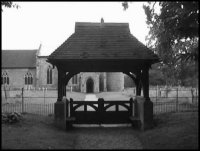
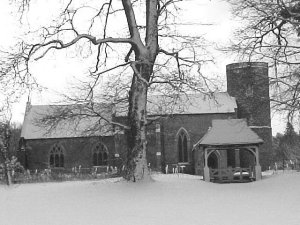
The Lych-gate (right) is also a memorial to
Rev'd Crabbe which holds the following inscriptions " In
loving memory of Rev'd George Crabbe died Aug 7th 1884 aged 65. Also Emily
his wife, died Jan 7th 1854 aged 23. Also Anna eldest daughter, died Sept 18th
1868 aged 16. Erected to there memory by the surviving child Emily Rivett Carnac,
died March 22nd 1894 aged 40, Whom is buried next to her sister at the cemetery
Brighton.
Description :- A Lych-gate is a
covered open structure, found at a church gate. It normally
consists of four or six oak posts embedded in the ground in a
rectangular shape . On top of this are a number of beams to hold
a steeply sloping straight pitched roof covered in wooden or clay
peg tiles. Details :- The name is derived from the Saxon Lych
meaning "corpse" and gate meaning entrance. Hence
corpse entrance. Use :- The lych gates were built from about the
mid 15th century. It was the custom at the time for priests to
conduct the first part of the funeral service under its shelter,
a momentary pause symbolized the transition from life to death.
During medieval times the rich were the only people buried in
coffins. The poor were carried to the lych gate and placed on a
stone or wooden table covered in a shroud before burial.
In the park once stood a oak tree of antiquity, which
measured 23'4" in circumference at 6' from the ground, fell in January 1892 and
proved to be very hollow.
Click on one of
the links below to make other searches related to the Church
|
Click Hand for inside view |
|
Vittoria Colonna & Mystery |
|
 |
|
 |
Below Various views taken 2001/2002.
You may be
viewing this page with no menu, If this page does not
show a menu,
click on View Menu below.

|
|